C4 System Design — the minicloud Platform
The platform's solution-architecture model — the platform is made of these components, working together like this. Modelled once as a Structurizr DSL (
workspace.dsl) and rendered to C4-model diagrams — diagram-as-code, so it never drifts. Every relationship is verified against the GitOps manifests (no invented edges).
Boundary: this models the Platform — the shared technical capabilities (the internal cloud provider). The Information System (the insurer's business apps) appears as a single external consumer and gets its own C4 model later. See the Architecture Hub for how the two pillars relate.
Two lenses, same facts. Each view is shown as the icon-rich visual (brand logos + verb-labelled
edges, mingrammer diagrams); the equivalent formal C4 notation (Structurizr, standard boxes) is
linked beside it. Click any diagram to open it full-screen. The complementary capability map,
technology topology and physical view live on
Platform Architecture.
Jump to · ① Context · ② Container · ③ Deployment · ④ Subsystem deep-dives
① System Context — who the platform talks to
The platform as one system, its users, the external systems it depends on, and the Information System as its consumer.
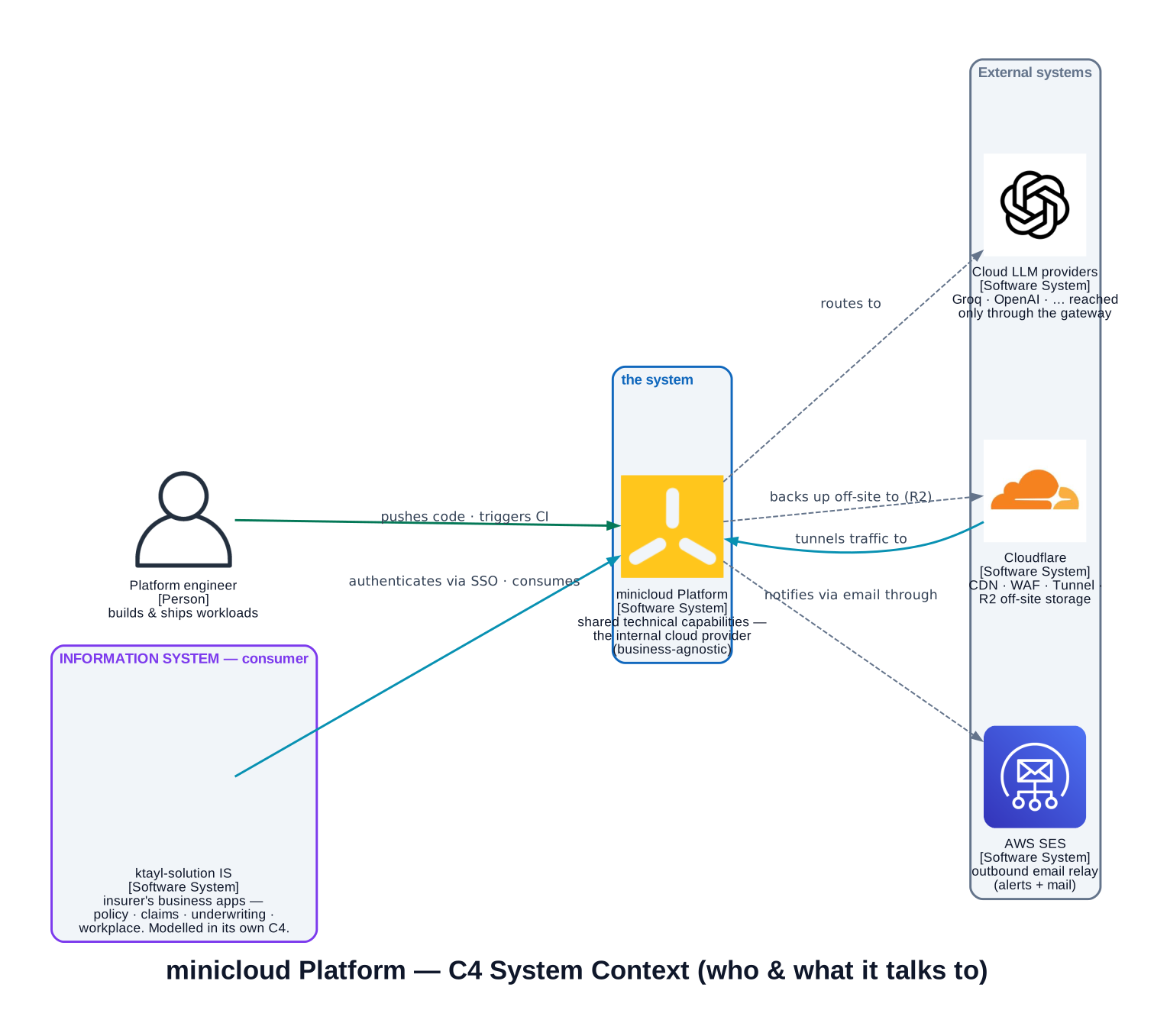
Formal C4 notation (Structurizr): Context diagram →.
② Container — the complete platform (all capabilities)
The whole platform in one view: every capability as a container, grouped (Access & Networking · Delivery/GitOps · Security & Secrets · Data & Messaging · Storage & Backup · Observability · AI Runtime · Runtime & Tooling), with the relationships that make it work — code→production (Delivery), request→app (Access), secrets, telemetry, backup, and what the IS consumes. It's detailed — click to open full-screen and zoom.
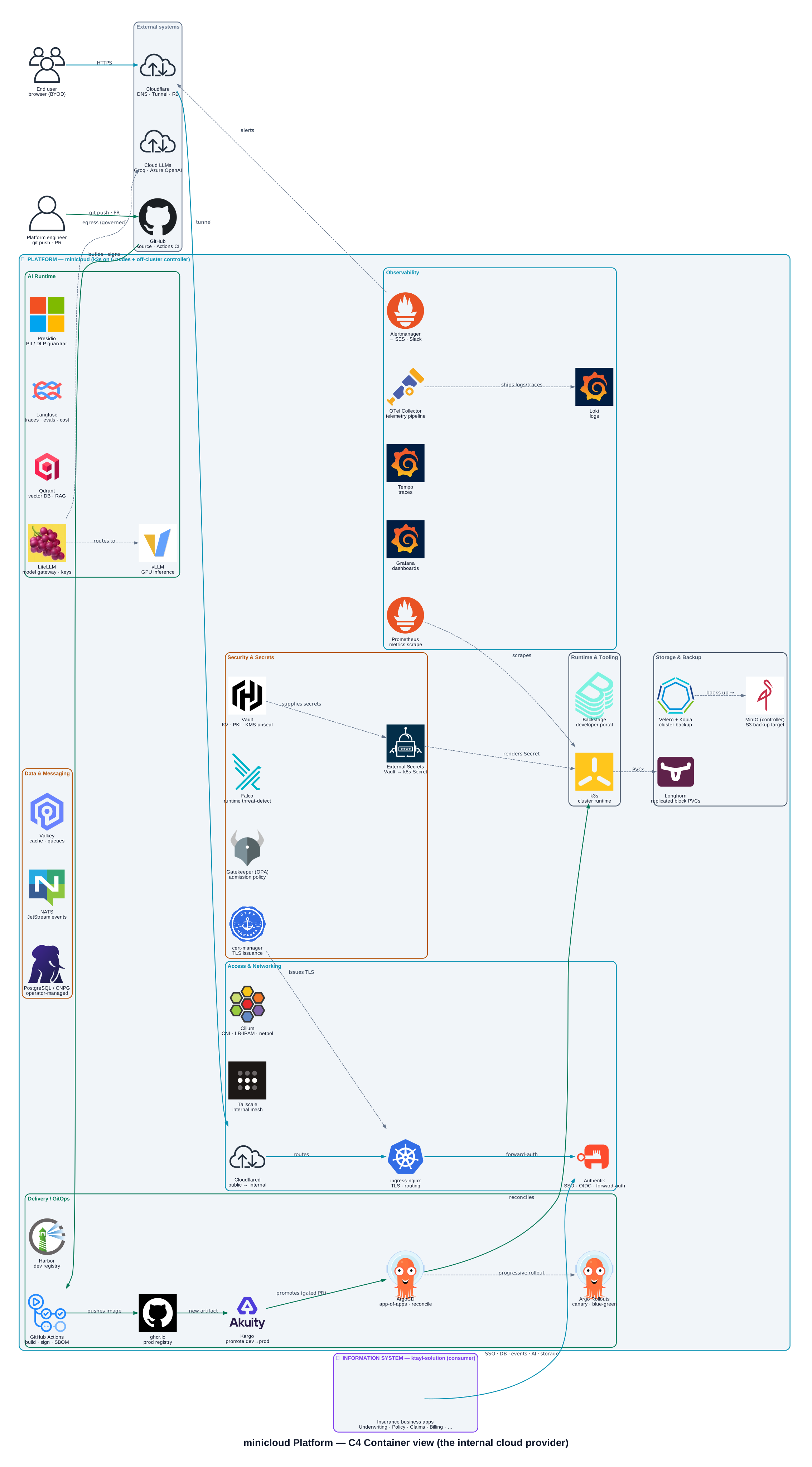
Formal C4 notation (Structurizr): Container diagram →.
Drill into a subsystem → GitOps / ArgoCD · Secrets / Vault+ESO · AI / LiteLLM — or follow a flow: delivery · request · observability.
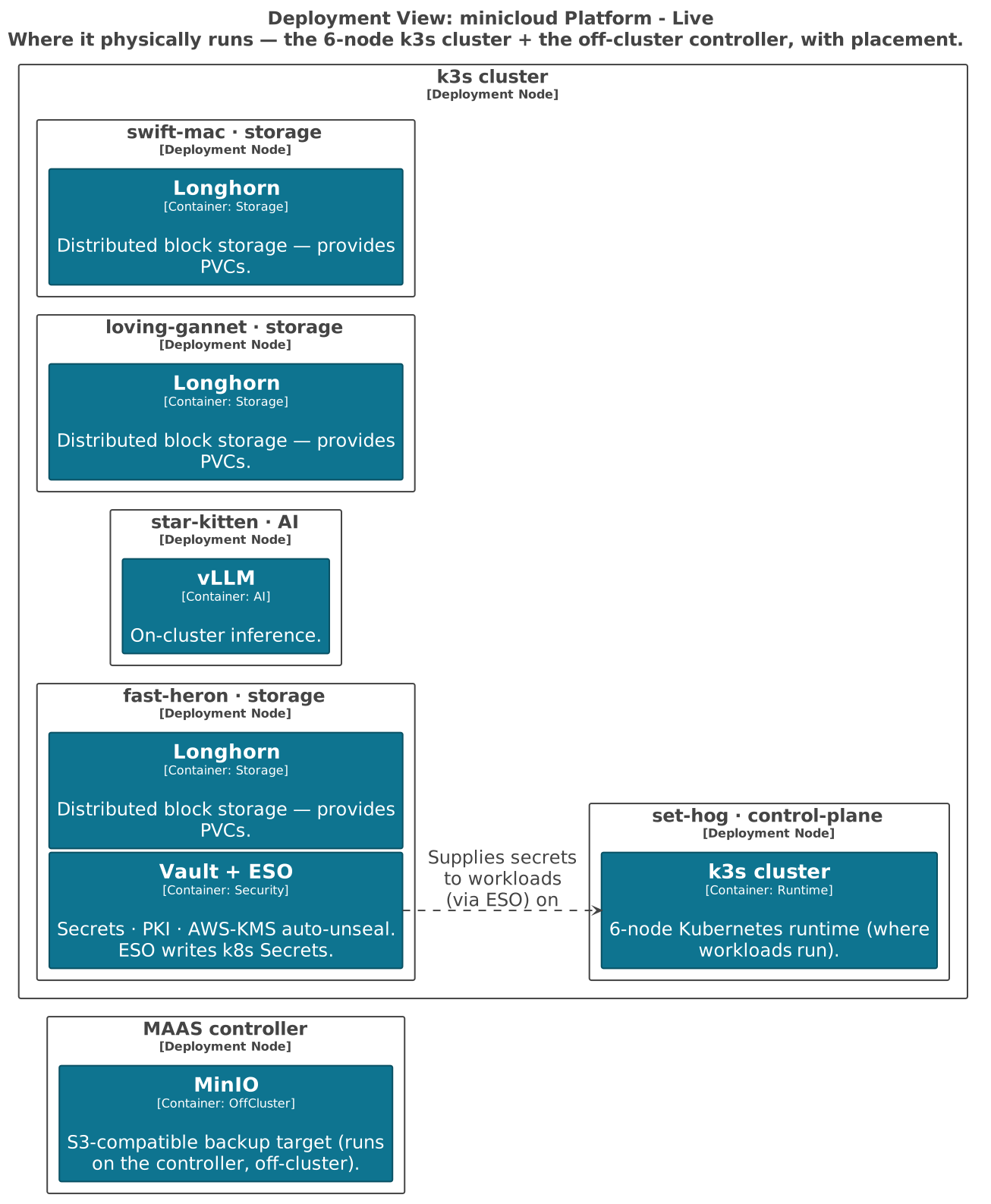
③ Deployment — where it physically runs
The same model, deployed: the 6-node k3s cluster + the off-cluster MAAS controller, with placement (Vault → fast-heron, vLLM → star-kitten, control-plane → set-hog) and Longhorn replicated across the storage nodes.
Subsystem deep-dives (C4 Component + flow)
Zooming inside the key containers — "the GitOps platform in detail", and the same for secrets and the AI gateway. All grounded in the GitOps manifests + the platform rules. (Click any diagram to enlarge.)
How code reaches production — the delivery flow
A git push to a running production workload (CI → registries → Kargo → ArgoCD → cluster), showing the
continuous-delivery vs continuous-deployment split: the same artifact is built+proved once, Kargo
auto-deploys it to dev (continuous deployment — no human), then a CODEOWNERS-gated PR promotes it
to prod (continuous delivery — a human decides when). The full narrative is on the
Delivery Workflow page.
System-design view — icon-rich, the four stages colour-coded (grey build · cyan promote · green = automatic dev · amber = human-gated prod). Open full SVG →
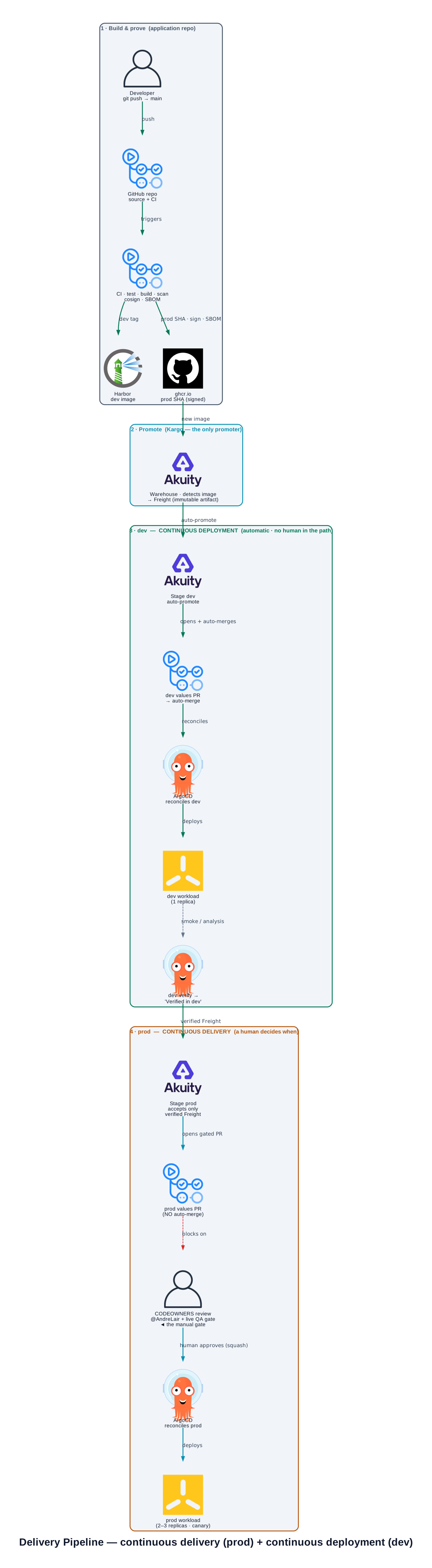
Formal C4 dynamic view — the same sequence in standard C4 notation (Structurizr). Open full SVG →

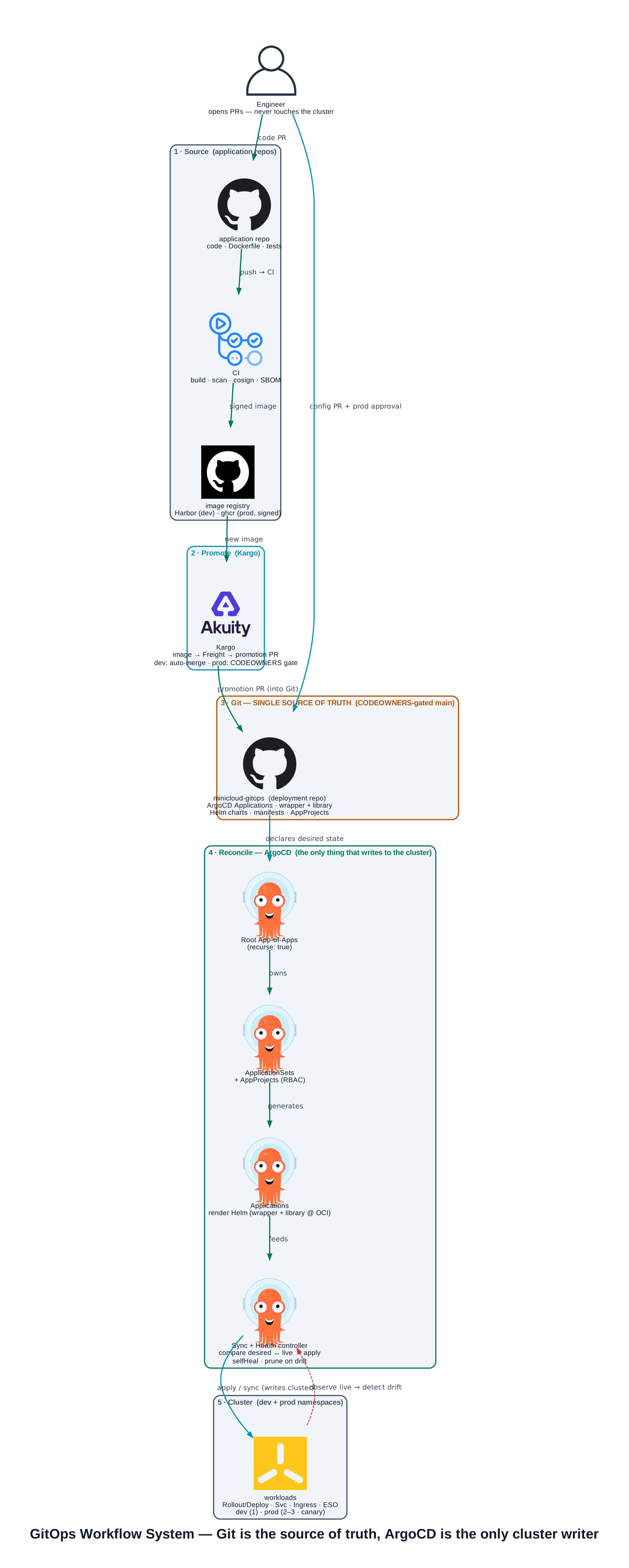
The GitOps workflow system (the reconcile loop)
The whole GitOps system in one view — where the delivery flow follows the artifact, this follows the control loop: humans and Kargo only ever write to Git (the single source of truth); ArgoCD is the only thing that writes to the cluster, continuously reconciling desired state (Git) against live state and self-healing drift. Shows the two-repo model, Kargo promotion (dev auto / prod CODEOWNERS-gated) into Git, the app-of-apps tree, the Helm wrapper+library render, and the drift-correction loop (red). Open full SVG →
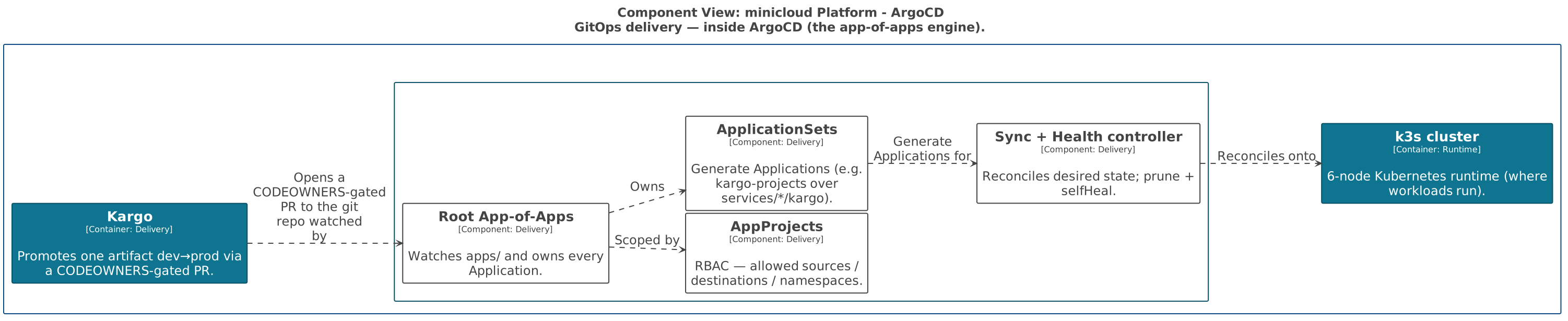
GitOps delivery — inside ArgoCD
Zooming inside the reconcile engine above: Root App-of-Apps → ApplicationSets / AppProjects → Sync+Health controller → the cluster; Kargo opens the CODEOWNERS-gated PR.
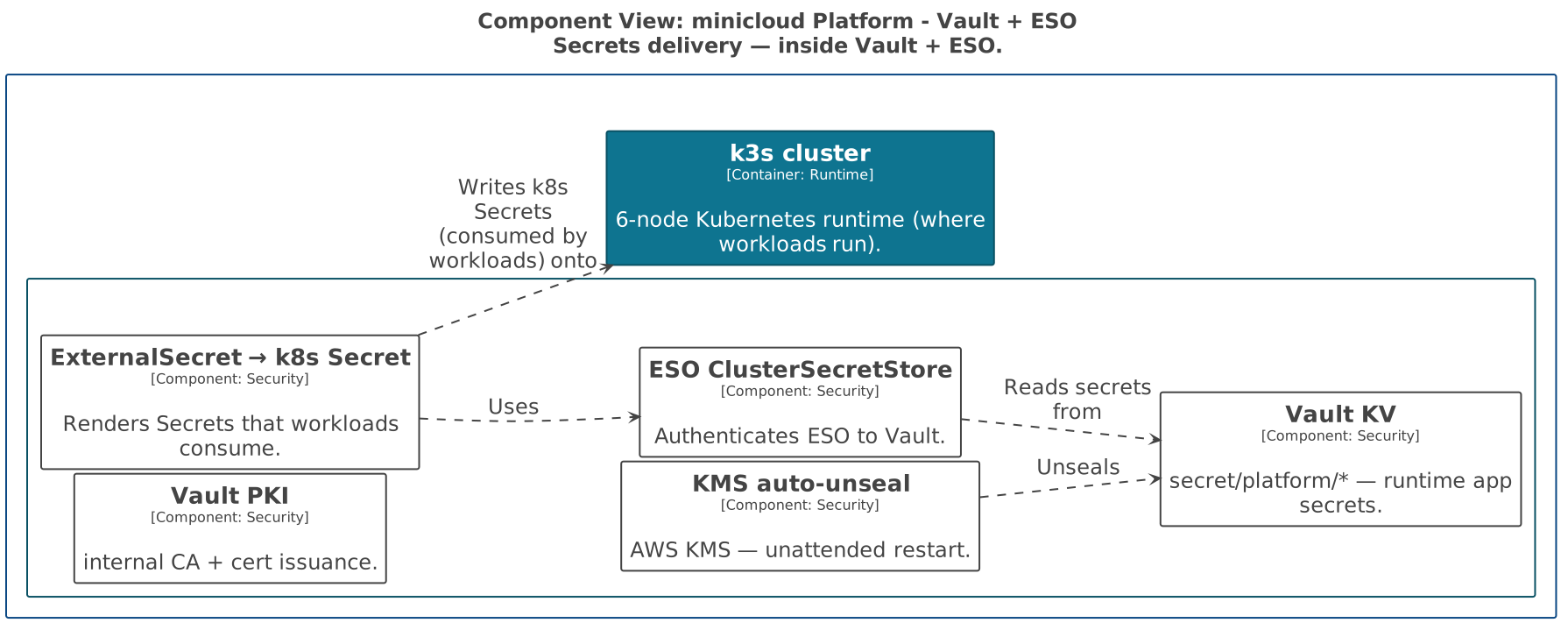
Secrets delivery — inside Vault + ESO
Vault KV/PKI (KMS auto-unseal) → ESO ClusterSecretStore reads Vault → ExternalSecret renders the k8s Secrets workloads consume.
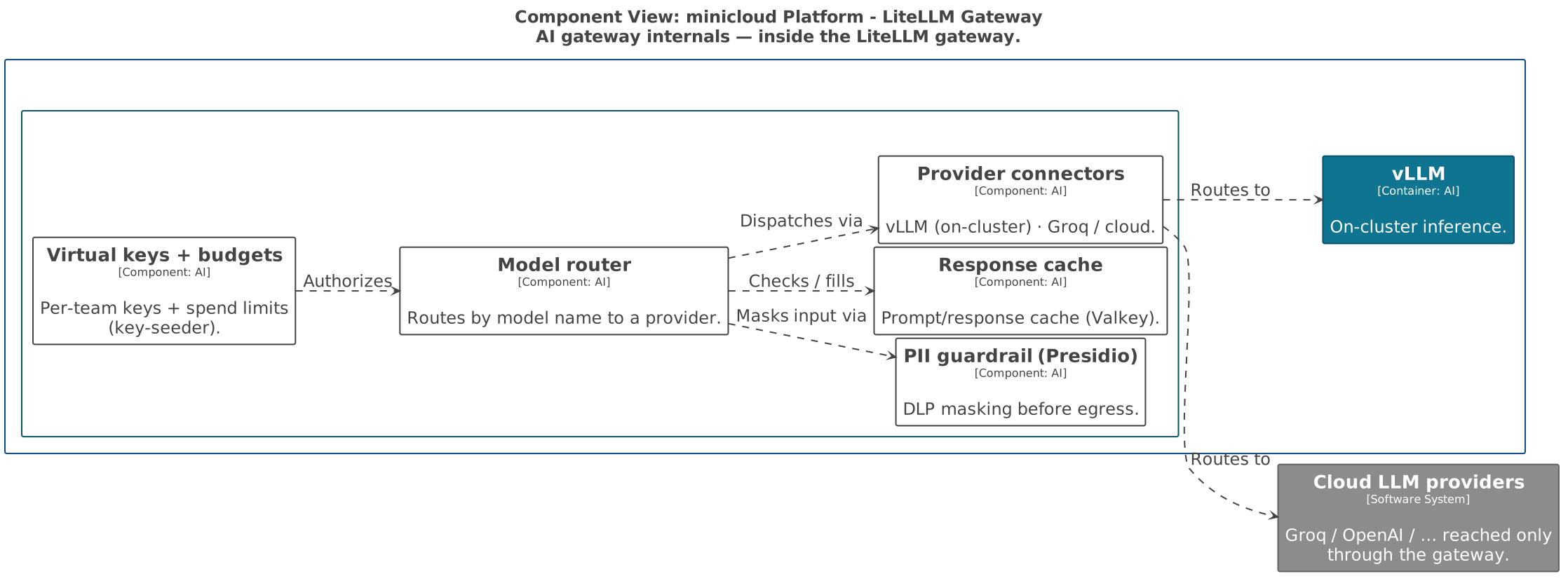
AI gateway — inside LiteLLM
Virtual keys/budgets → model router → PII guardrail (Presidio) + cache + provider connectors (vLLM / Groq / cloud).
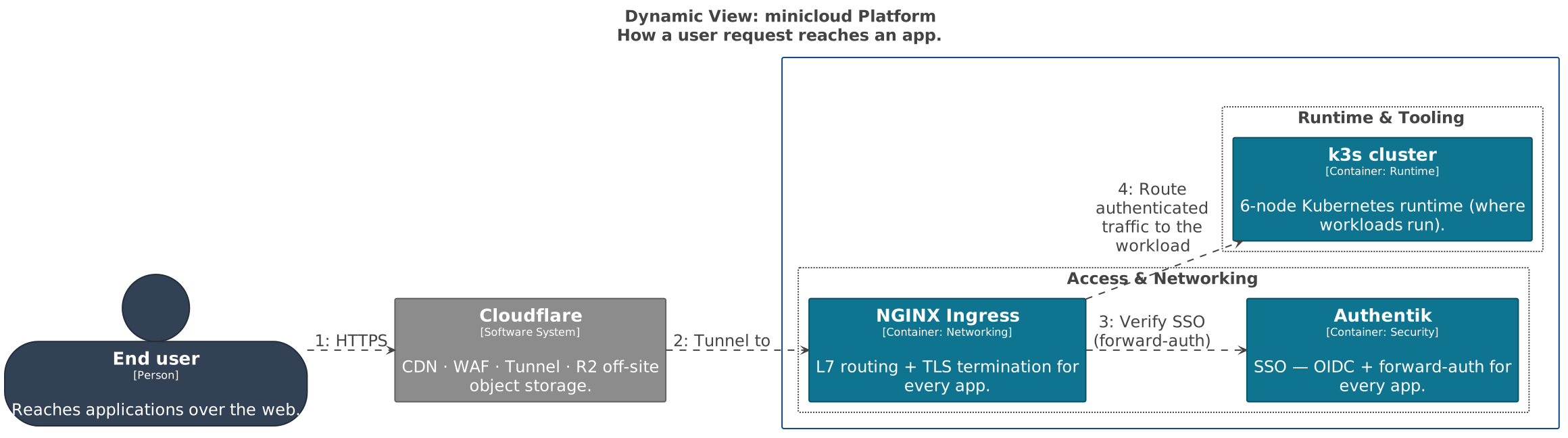
How a request reaches an app (networking flow)
User → Cloudflare → tunnel → ingress → Authentik (forward-auth) → the workload.
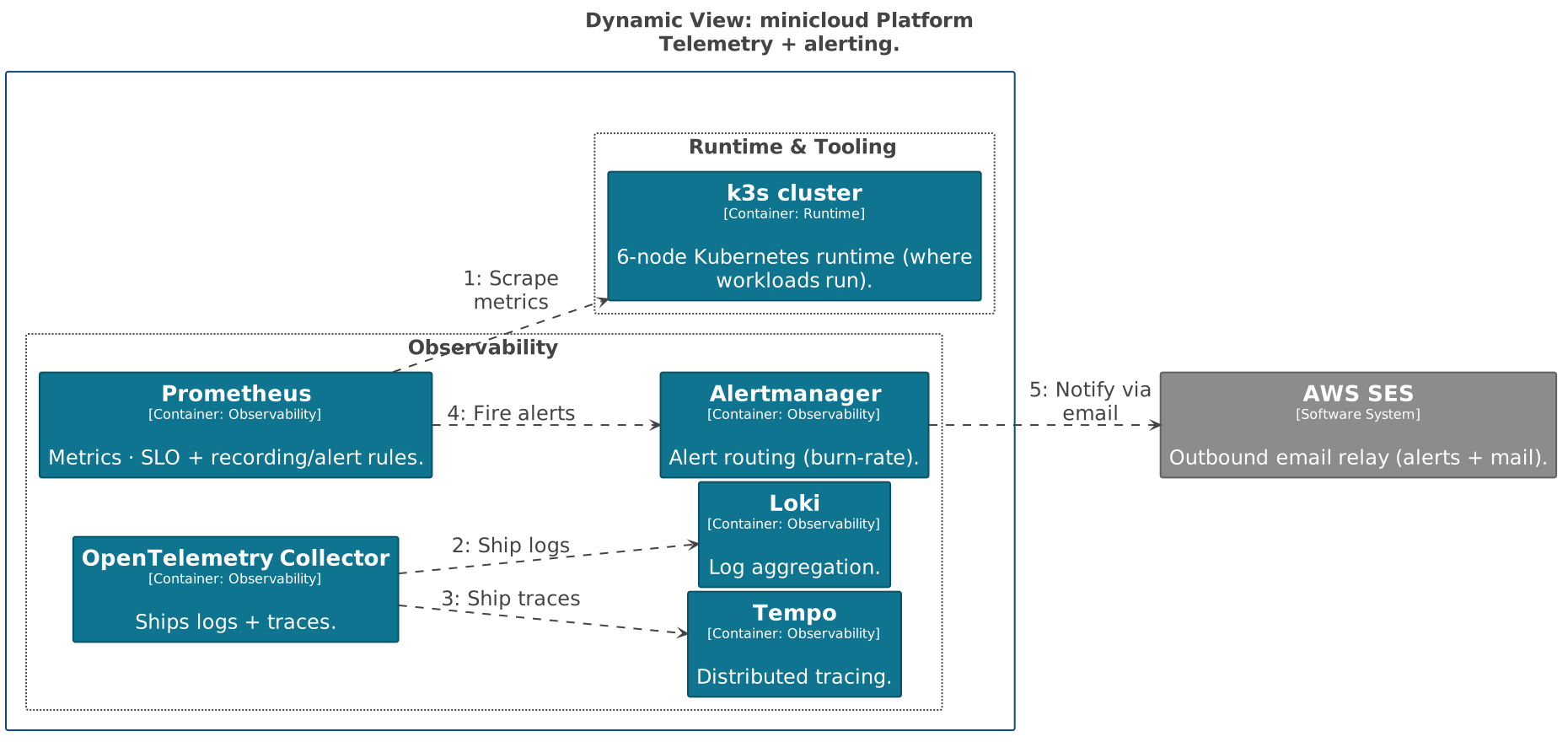
Telemetry + alerting (observability flow)
Prometheus scrapes the cluster · OTel ships logs→Loki / traces→Tempo · alerts → Alertmanager → SES email.
Further subsystem views are cheap to add — the model already holds the elements; just add a
component/dynamicview toworkspace.dsl.
Legend
- Shapes (C4): rounded person = a Person; blue box = the Platform (software system); grey box = an external system; purple box = the Information System (the platform's consumer); teal/coloured boxes = containers (platform capabilities, tinted by group).
- Arrows: every arrow is a relationship with a verb (builds · pushes · promotes · reconciles · supplies-secrets · issues-certs · authenticates · scrapes · ships-logs · backs-up · routes-to · consumes).
- Each formal view also has a C4 key (auto-generated):
structurizr-<view>-key.svg.
Maintaining it
Edit diagrams/structurizr/workspace.dsl,
run make c4 (Structurizr CLI → PlantUML → SVG, via Docker), commit the refreshed SVGs — a CI workflow
also regenerates on change. This is the single source of truth for the platform's C4 views; the
capability map / technology topology / physical view
remain the complementary stylistic references.