Production Stack Architecture
Platform Architecture — the technical capabilities of the minicloud platform (6-node on-premises k3s, 44 cores / ~84 GiB), in three complementary, icon-rich views: a capability map (understand in 30s), the detailed technology topology (engineering reference), and the physical / deployment view (where it runs + failure domains).
:::tip Two complementary approaches — pick the right lens
These are the icon-rich views (mingrammer diagrams). For the formal, standard-notation C4 model
of the same platform — System Context → Container → Deployment, from a single Structurizr source — see
C4 System Design. The C4 page is the rigorous model; this page
is the visual reference. Same facts, different lens.
:::
:::info This view is Platform-only (by ownership, not deployment) The business applications that run on this platform (ERPNext, the digital workplace, the custom insurance LOB services…) are Information-System-owned and live in the IS Application Landscape — not here. A Claims app running on this cluster is still an IS application. See the Architecture Hub for how the two pillars fit together and the Platform ↔ IS dependency matrix. :::
1. Platform Capability Architecture
The 30-second view — the platform's capabilities and principal flows. Boxes are capability groups (not individual products); every arrow is a verb.
Legend — boxes = platform capability groups; arrows = a verb; the purple box = the Information System (business apps, a separate view). It answers the six questions: how code reaches prod (①→④), how it's secured (②③), how workloads are exposed (②), how secrets/data are managed (③⑤), how failures are detected (⑦), and what the platform provides to the IS (the final edge).
2. Platform Technology Topology (detailed reference)
The full icon topology — generated from code
(platform_overview.py,
mingrammer diagrams). It's logical (a capability map, not a liveness claim). Preview below (PNG,
instant); open the ▶ vector SVG → ·
PNG → (both self-contained).
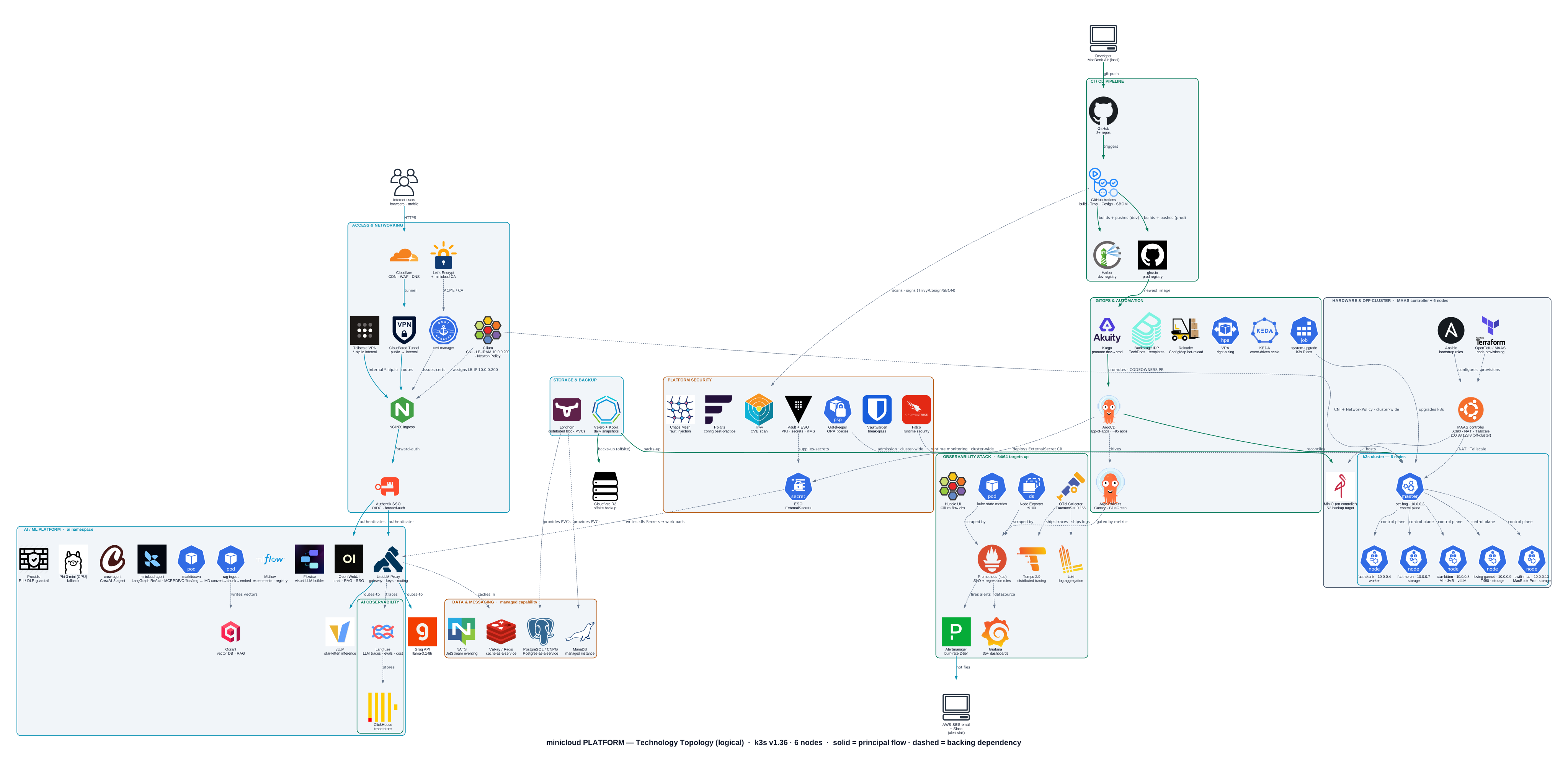
Legend / edge vocabulary — solid = principal flow (request · delivery · routes-to) · dashed = backing dependency. Verbs: builds · pushes · promotes (CODEOWNERS PR) · reconciles · issues-certs · authenticates · supplies-secrets · scrapes · ships-logs/traces · backs-up · routes-to. Cluster-wide substrates (Cilium CNI+LB, Gatekeeper admission, Falco runtime) are labelled (cluster-wide); MinIO is off-cluster (on the MAAS controller). Every edge is verified against the GitOps manifests.
3. Platform Physical / Deployment view
Where it actually runs — the 6 nodes, their roles, pinned workloads, Longhorn replication, and failure domains. Open the ▶ vector SVG → · PNG →.
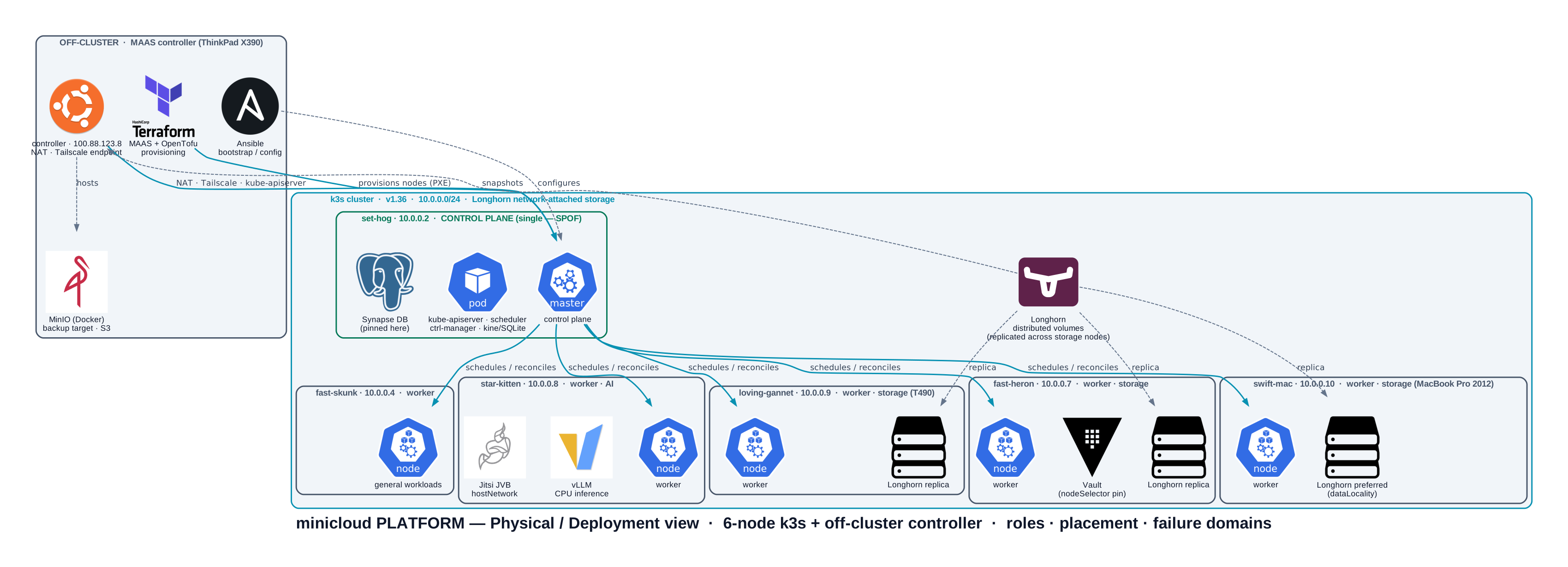
Legend — set-hog is the single control-plane node (control-plane SPOF; kine/SQLite is
backed up). Workers run general/AI workloads; the storage nodes (fast-heron · loving-gannet ·
swift-mac) hold Longhorn replicas. Vault is pinned to fast-heron; vLLM + Jitsi JVB to
star-kitten. The MAAS controller is off-cluster (NAT · Tailscale · MinIO backup target). Longhorn is
network-attached, so a pod fails over to any node — the hostname labels show current placement, not a
hard pin.
The original hand-made HTML poster was retired 2026-10-17 — these code-generated views (and the C4 System Design) supersede it.
Platform at a Glance
| Dimension | Value |
|---|---|
| Nodes | 5 ThinkPads + MacBook Pro 2012 — 44 cores / ~84 GiB (1 control-plane + 5 workers) |
| k3s version | v1.36.3+k3s1 (all 6 nodes) |
| ArgoCD apps | ~93 live applications |
| PrometheusRule objects | 53 (monitoring ns + podinfo) |
| Grafana dashboards | 43+ |
| GitOps repos | 11 (dev images → Harbor via Tailscale; prod images → ghcr.io, SHA-tagged) |
| Phases complete | 0–90 |
Architecture Layers
Access Layer
All traffic enters through a single MetalLB IP (10.0.0.200). Two paths:
- Public (devandre.sbs): Cloudflare CDN → Cloudflare Tunnel (k8s Deployment, 2 replicas,
cloudflare-tunnelns, anti-affinity spread across workers) - Internal/VPN: Tailscale → NGINX Ingress directly via
*.10.0.0.200.nip.io
Every application is protected by Authentik SSO (OIDC + TOTP) via NGINX forward-auth ingress annotations. cert-manager handles TLS for both Let's Encrypt (public) and the minicloud root CA (internal).
:::note Cloudflare Tunnel — HA since 2026-08-13
Cloudflare Tunnel moved from a controller systemd service to a 2-replica Kubernetes Deployment (PRs #678+#679). Tunnel remains active during controller reboots. SSH backup path: controller.devandre.sbs → ssh://10.0.0.1:22 (PR #680).
:::
GitOps & Automation
:::note Promotion is now Kargo-driven (staging retired)
The flow below is the historical CI-drives-promotion shape. Since 2026-08, promotion is
trunk-based: CI on main builds + proves one immutable artifact, Kargo promotes it
dev → prod (CODEOWNERS-gated), and Argo CD deploys it. The staging environment/branch was
removed. See the Delivery Workflow
and Kargo pages for the current model.
:::
Developer push → GitHub Actions (CI)
                    ├── Build → Trivy scan → Cosign sign → syft SBOM
                    ├── Push → Harbor (via Tailscale tag:ci)
                    └── bump-gitops (GPG-signed PR) → ArgoCD auto-sync
                              │
                              ├── canary-load (parallel) — k6 5 min sustained
                              └── rollout-gate (parallel) — polls Rollout phase
                                        │
                                        └── promote-staging (needs both pass)
ArgoCD manages ~93 apps via the app-of-apps pattern from minicloud-gitops. All Helm values live in helm-values/, never in minicloud-ansible/.
Argo Rollouts handles progressive delivery:
platform-demo: Canary 50% → AnalysisRun (Prometheus gates) → 100%minicloud-plane: BlueGreen prePromotion (health) + postPromotion (Prometheus)
Security
| Component | Role |
|---|---|
| Vault (HashiCorp CE) | PKI, secrets, AWS KMS auto-unseal, fast-heron pinned |
| ESO | ExternalSecrets from Vault KV to k8s Secrets |
| Gatekeeper OPA | 18 constraints: require-non-root, no-privilege-escalation, no-hostpath, block-capabilities, require-seccomp, and more |
| Falco | Runtime syscall monitoring, DaemonSet |
| cert-manager | Let's Encrypt (public) + minicloud CA (internal) |
| Vaultwarden | Timshel fork 1.34.1-6, SSO via Authentik |
| NetworkPolicies | default-deny-ingress on all namespaces |
| kube-bench | k3s-CIS-1.7: 16/16 PASS on all workers |
| Chaos Mesh | Fault injection for Game Day reliability testing |
| cosign + SBOM | Supply-chain: every prod image (ghcr.io) is signed + has SBOM attached |
AI / ML Platform
User-facing AI interfaces:
  Open WebUI (chat.devandre.sbs)  — conversational chat, RAG, model switching
  Flowise 2.2.7 (flowise.devandre.sbs) — visual LLM flow builder, no-code pipelines
    │
    └→ LiteLLM Proxy (2 replicas, KEDA auto-scale)
            ├→ vLLM v0.6.6 (Phi-3-mini, on-cluster)
            ├→ Groq API (llama-3.1-8b-instant, primary for phi3-financial)
            ├→ OpenAI text-embedding-3-small (embeddings, 1536-dim)
            ├→ DeepSeek, Mistral (cloud, via LiteLLM routes)
            └→ minicloud-agent / minicloud-crew-agent (OpenAI-compat endpoints)

RAG pipeline:
  Document → markitdown-proxy (PDF/Office/images → Markdown via Docling)
           → rag-ingest (chunk → embed → store)
           → LiteLLM → OpenAI text-embedding-3-small (1536-dim)
           → Qdrant (policy-docs, incident-reports, regulatory collections)

AI agents:
  minicloud-agent 1.0.1     — LangChain single-agent, MCP tool layer
  minicloud-crew-agent 1.0.1 — CrewAI multi-agent, insurance workflow automation

Observability:
  Langfuse: TTFT, tokens/s, cost/request, prompt eval scores, 90-day trace retention
  LiteLLM Prometheus: litellm_proxy_total_requests_metric_total, input tokens
  vLLM dashboard: vllm-inference-v1 (7 panels, ServiceMonitor in ai ns)
Specialised AI services (all in ai namespace, managed under litellm ArgoCD app):
| Service | Version | Purpose |
|---|---|---|
| vLLM | v0.6.6 | GPU-optimised LLM inference (CPU on-cluster) |
| MLflow | v2.16.0-psycopg2 | Experiment tracking, model registry |
| Flowise | 2.2.7 | Visual LLM flow builder |
| minicloud-agent | 1.0.1 | LangChain agent + MCP |
| minicloud-crew-agent | 1.0.1 | CrewAI multi-agent |
| Presidio | latest | PII detection + anonymisation |
| Langfuse | 3.x | LLM observability (ClickHouse backend) |
| Open WebUI | custom | Chat interface, French BM25 RAG |
| Qdrant | 1.x | Vector store (RAG collections) |
phi3-financial PromptOps pipeline: routes through groq/llama-3.1-8b-instant (primary, weight 10) with vLLM phi3-mini as fallback. 25/25 CI eval cases pass.
Automation & Workflows
| Service | Namespace | URL | Notes |
|---|---|---|---|
| n8n 2.32.7 | automation | n8n.devandre.sbs | Phase 83, 5Gi Longhorn RWO |
| Temporal v1.31.2 | temporal | temporal.devandre.sbs | Phase 84, 4 historyShards (PERMANENT), PostgreSQL backend |
Observability
The observability stack uses five complementary tools:
| Tool | Purpose | Key metric |
|---|---|---|
| Prometheus | metrics collection + alerting | 53 PrometheusRule objects |
| Grafana | dashboards + explore | 43+ dashboards, TraceQL, LogQL |
| Loki | log aggregation | OTLP native, 30-day retention, LogQL ruler |
| Tempo 2.9.0 | distributed tracing | TraceQL, tracesToLogsV2, 14-day retention |
| OTel Collector | log + trace shipping | DaemonSet, OTTL transforms, replaces Promtail |
| Alertmanager | alert routing | → Stalwart:587 → SES → kanmegnea@devandre.sbs + healthchecks.io watchdog |
Log pipeline (Gaps 1–7 closed):
- Promtail replaced by OTel Collector DaemonSet (otelcol-contrib 0.156.0)
- OTTL
transformprocessor: Kopia job cardinality collapsed,levellabel extracted and normalised - Controller logs via Promtail Docker container (
--net=hostfor MetalLB routing)
SLO & Regression Detection:
- 7 SLO objectives, 11 recording rules, burn-rate 2-tier alerts
- 5 regression alerts comparing current vs
offset 1hbaseline (latency, error rate, throughput, CPU, memory) RolloutAutoRollbackalert onargo_rollout_info{phase="Degraded"} == 1for 1m
Operational resilience:
- healthchecks.io: 3 checks — Alertmanager watchdog (
cc3f232b), controller heartbeat (b2ac9ab5), recovery failures (6a37bfa6) - minicloud-ops: Python recovery check, 15 health probes, systemd-managed on controller
Collaboration & Business Apps
| Service | URL | Notes |
|---|---|---|
| Stalwart Mail | mail.devandre.sbs | v0.16.13, JMAP API, RocksDB |
| AWS SES | eu-west-1 | outbound relay + inbound pipeline (production approved) |
| Matrix + Element | element.devandre.sbs | Synapse v1.156.0, dedicated postgresql-synapse in chat ns |
| ERPNext | erp.devandre.sbs | v16.28.0, French insurance config (PCG 2025, TSCA, LOBs, Factur-X) |
| Jitsi Meet | meet.devandre.sbs | v2.21.0, JVB pinned star-kitten, TURN = Lightsail 54.171.137.209 |
| Nextcloud | files.devandre.sbs | OnlyOffice DocumentServer, SSO |
| Plane CE | plane.devandre.sbs | project management |
| Vaultwarden | vault-pw.devandre.sbs | Timshel fork (SSO button), human credential store |
| Docuseal | sign.devandre.sbs | e-Signature (eIDAS Simple), 4 insurance templates |
| Flowise | flowise.devandre.sbs | visual LLM flow builder (ai ns) |
| MLflow | mlflow.devandre.sbs | ML experiment tracking + model registry (ai ns) |
| n8n | n8n.devandre.sbs | workflow automation |
| Temporal | temporal.devandre.sbs | durable workflow engine v1.31.2 |
Email flows (bidirectional, 2026-07-26):
- Outbound: Stalwart SMTP:587 → ses-relay → SES eu-west-1 → recipient
- Inbound: External → MX
inbound-smtp.eu-west-1.amazonaws.com→ SES Receipt → S3 → SNS → SQS → ses-ingest pod → Stalwart → mailbox
Storage
| Store | Location | Used by |
|---|---|---|
| Longhorn | Distributed (swift-mac preferred) | All stateful workloads with RWO/RWX PVCs |
| MinIO | MAAS Controller (Docker) | Velero backup bucket, kine SQLite backups, S3-compat |
| Qdrant | ai ns (Longhorn PVC) | RAG vector collections (1536-dim text-embedding-3-small via OpenAI) |
| PostgreSQL-ai | ai ns | MLflow, LiteLLM cache, RAG metadata |
| postgresql-synapse | chat ns, set-hog pinned | Matrix-synapse dedicated DB (migrated 2026-08-07) |
| ClickHouse | langfuse ns | LLM trace storage |
| MariaDB | erp ns | ERPNext data |
Backup layers:
- Velero (daily): Longhorn snapshots → MinIO
velero/bucket (local) - Velero off-site (weekly): Cloudflare R2
minicloud-velero-offsitebucket (72h TTL) - kine SQLite (daily):
sqlite3 .backup→ MinIOk3s-backup/+ controller timer →db-backups/kine/
multipathd gotcha (all 6 nodes): IET VIRTUAL-DISK devices blacklisted in /etc/multipath.conf to prevent Longhorn iSCSI volumes from being claimed as mpatha.
Hardware
| Node | IP | Role | Notes |
|---|---|---|---|
| MAAS Controller (ThinkPad X390) | 100.88.123.8 | NAT, MAAS, Tailscale, MinIO, cloudflared systemd (SSH backup path) | 98G NVMe |
| set-hog | 10.0.0.2 | k3s control-plane | Kine/SQLite, socat proxy for scheduler+ctrl-mgr metrics |
| fast-skunk | 10.0.0.4 | k3s worker | General workloads, NVMe-first boot (BIOS) |
| fast-heron | 10.0.0.7 | k3s worker | Vault pinned (nodeSelector) |
| star-kitten | 10.0.0.8 | k3s worker (ai,worker) | Jitsi JVB pinned (hostNetwork), vLLM inference |
| loving-gannet | 10.0.0.9 | k3s worker (storage,worker) | ThinkPad T490, Longhorn replica-holding (added after original build) |
| swift-mac | 10.0.0.10 | k3s worker (storage,worker) | MacBook Pro 13" 2012, Ubuntu 22.04, Longhorn preferred |
Boot order: Controller (30s) → cluster nodes (2 min) → Tailscale on Mac.
NVMe boot fix (2026-08-13): All 5 ThinkPads boot NVMe-first. fast-skunk via BIOS; fast-heron/star-kitten/set-hog/loving-gannet via efibootmgr --create.
Power failure recovery: NAT is automated (restore-cluster-nat.service on controller — no manual step needed). MinIO requires a manual restart after disk-full events (caches error state in memory):
ssh controller "docker restart minio"
Key Design Decisions
Why on-premises? Portfolio-grade work demonstrating infrastructure ownership, cost awareness, and operational discipline beyond managed cloud. All compute, networking, and storage decisions are explicit.
Why app-of-apps? Single ArgoCD application (minicloud-gitops) owns everything. New services are added by dropping an apps/<name>.yaml file — no manual ArgoCD config.
Why a hybrid Harbor + ghcr.io registry? Since 2026-08-27 the split is deliberate: dev/ephemeral images live in Harbor (on-premises via Tailscale — air-gap-capable, Trivy CVE scanning, keep-10 retention + daily GC to bound controller disk), while prod images live in ghcr.io (free, durable, off local disk, SHA-tagged + Cosign-signed with SBOM attached). This keeps the controller's disk budget bounded without giving up supply-chain guarantees on production artifacts.
Why OTel Collector instead of Promtail? Stack-agnostic — only the exporter block changes when swapping backends. OTTL transforms handle cardinality normalization and label extraction without coupling to Loki's scrape config format.
Why Stalwart + SES instead of a managed email provider? Full control over deliverability, DKIM rotation, and JMAP automation. SES production access (50k msg/day) eliminates sandbox restrictions at near-zero cost.
Why Qdrant over pgvector? Dedicated vector DB with named collections, HNSW indexing, and snapshot API. pgvector is still running in postgresql-ai for legacy RAG metadata; new collections use Qdrant with OpenAI text-embedding-3-small (1536-dim, routed via LiteLLM).
Why Cloudflare Tunnel in k8s (not systemd)? 2-replica Deployment with pod anti-affinity eliminates the ~90s devandre.sbs outage that occurred on every controller reboot. Cloudflare load-balances across connectors automatically.